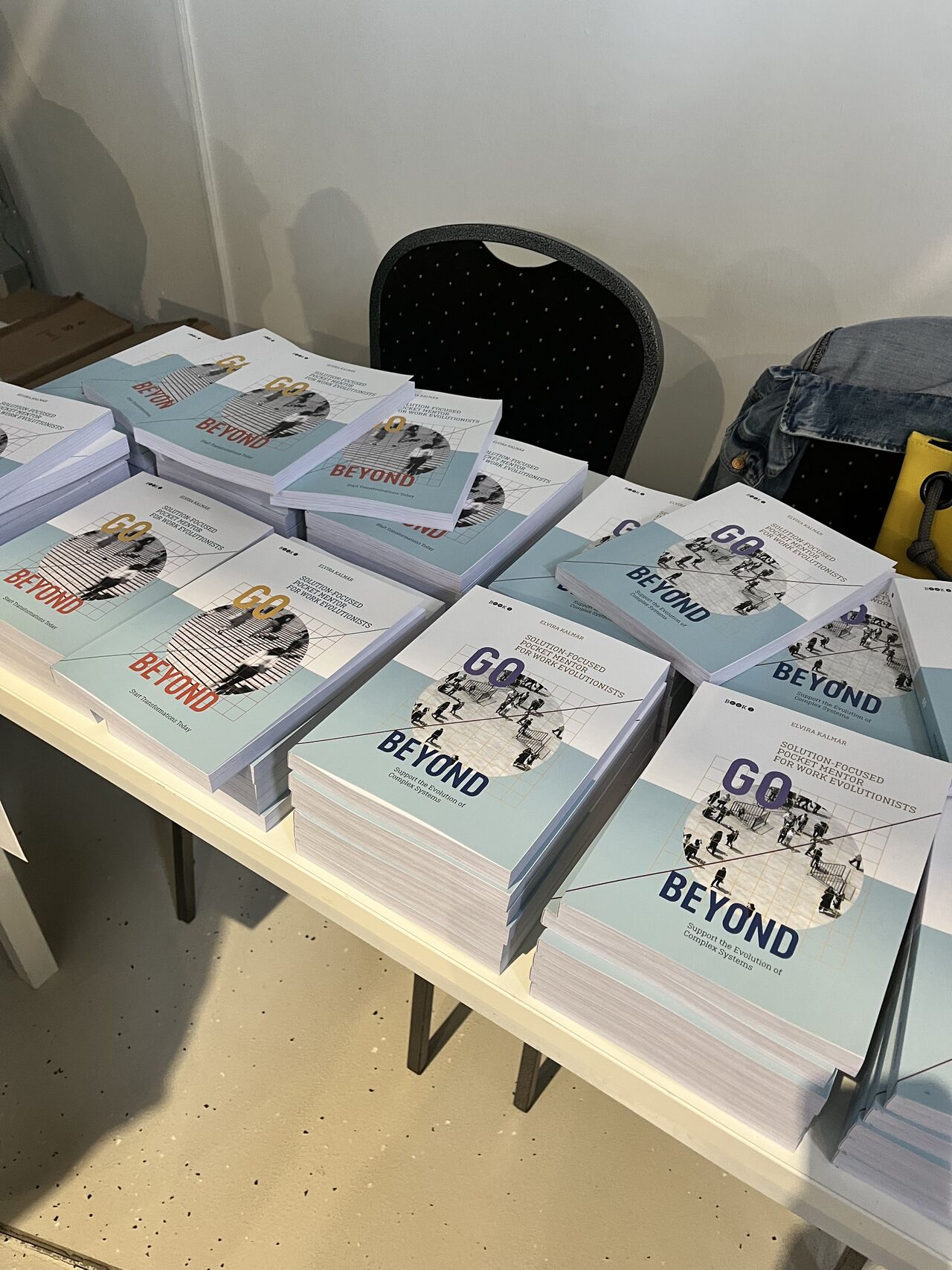
I have now encountered Elvira Kalmar’s thinking in three different ways: first through Go Beyond: Solution-Focused Pocket Mentor for Work Evolutionists – Book 1, then through Go Beyond: Solution-Focused Organisational Development and Design – Book 2, and most recently through her conversation on the Toward Solutions Podcast.
Listening to the podcast felt less like encountering a new set of ideas and more like hearing the books come alive.
When I reviewed Book 1, I admitted that my first reaction to the term Work Evolutionist was slightly cynical. I wondered whether it might be an attractive phrase created before the theory behind it. Reading the book changed my mind. What became apparent was that the idea emerged from years of practical work with organisations, with Solution Focused principles running throughout it.
Book 2 moved me considerably further. The first book connected readily with much of what I already knew as a Solution Focused practitioner: conversations, reframing, noticing resources, small steps and practical interventions. Book 2 challenged me to think beyond the conversation and towards the organisation itself, not merely as a collection of individuals, but as a complex, evolving system. The podcast brings those two perspectives together particularly well.
Perhaps organisations don’t need transforming
One of the ideas that now stands out most strongly for me is Elvira’s distinction between transformation and evolution.
Transformation usually suggests an organisation at Point A that needs to be redesigned into Point B. Somebody, frequently consultants or senior management, determines what Point B should look like, develops the new structure and then attempts to move everybody towards it.
Elvira offers something quite different. Rather than beginning with extensive diagnosis of what is wrong, the organisation begins by co-creating what its next level might look like. The people who actually inhabit the organisation become participants in creating that future rather than recipients of somebody else’s solution.
That distinction matters. It is also deeply Solution Focused.
In individual coaching we do not assume that the coach possesses the answer and must somehow transfer it to the client. We trust that people possess resources, knowledge, experience and possibilities that can be surfaced through the conversation. Why should organisations be fundamentally different?
Elvira’s proposition is that they aren’t. The organisation already contains enormous amounts of knowledge about what works, what could work and where the energy for change already exists.
Trust is not a soft extra
The podcast repeatedly returns to trust, and this particularly resonated with me.
A Solution Focused practitioner approaches another person with a particular stance: you have capabilities; you have resources; things are already happening that may be useful; and you are capable of contributing to what happens next.
Elvira extends that stance to organisational life. If leaders genuinely trust the people closest to the work, the question changes from, How do we get people to implement our change? to something much closer to, What could we create together?
She gives a wonderful example from her own organisational experience. She inherited what she describes as an extremely demotivated team. Within a year, the same group had become something of an “island of happiness and success”, with other managers asking what on earth was happening inside those team meetings. At the same time, the team was completing roughly twice the volume of work expected of it.
What interests me is that the increased performance was not produced by squeezing harder. It emerged alongside energy, laughter, appreciation, clarity and shared purpose. That should make anyone interested in organisational psychology pay attention.
From fixing weaknesses to creating agreements
One word from the podcast has particularly stayed with me: agreements.
Elvira argues that organisation design is fundamentally about agreements concerning two deceptively simple questions: What is the work we are here to do? and How are we going to do that work together?
There is something refreshingly uncomplicated about this. Organisations can create extraordinary amounts of noise around culture, structure, values, transformation strategies, engagement initiatives and restructuring while failing to establish clear agreements about the actual work.
This is also where Elvira distinguishes organisational development from simply doing team coaching inside an organisation. A Solution Focused conversation may create hope, connection and energy, but within an organisation there eventually has to be a conversation about the work.
What are we going to deliver? Who is going to contribute? What will be different? How will we know?
Without this, positive conversations risk becoming detached from the purpose for which the organisation exists. People may discuss collaboration extensively without having agreed what they are actually going to deliver together. That distinction sharpened my own thinking considerably.
Start with what the customer would notice
One of my favourite practical ideas in the conversation is wonderfully simple.
Rather than asking, What should we change?, Elvira suggests beginning somewhere else: If we took a useful step forward in our evolution, what would our customers or clients notice?
That small shift takes the conversation immediately towards impact rather than internal organisational machinery. Perhaps customers would notice faster responses, greater consistency, better communication, more reliability or a more human experience.
Only then do we work backwards: If they were noticing that, what would we be doing differently? What would colleagues notice? What would contributors be doing differently?
This outward-in way of thinking prevents organisational development from becoming preoccupied with organisational charts and structures rather than the value an organisation exists to create.
It also sounds remarkably similar to a Solution Focused preferred-future conversation. What will be happening? Who will notice? What will they notice? What difference will that make? The questions scale remarkably well.
Stop, Start, Continue — but make agreements
Another practical element I took from both the books and the podcast is Elvira’s use of Stop … Start … Continue.
Many organisations will already recognise the tool. What makes her use of it different is the Solution Focused context around it.
First, notice what has been achieved. Then notice the contribution of individual people to that achievement. Only after creating that foundation of progress and capability do we ask what we should continue doing because it is helping, what we might stop doing because it is no longer useful, and what we could start experimenting with.
I particularly like the word experimenting. It removes some of the heaviness from change.
We are not declaring that the organisation must adopt a new permanent way of working from Monday morning. We are saying: let’s try this, notice what happens, see whether it moves us towards what we want, and then decide what that invites us to do next.
This is evolution rather than transformation. Small loops of action, noticing and adjustment gradually become larger loops as organisational confidence develops.
The calibration meeting
Elvira’s description of what she calls a calibration meeting also caught my attention.
The meeting has four broad elements: notice what has been achieved since the last meeting; acknowledge each person’s contribution to that progress; agree what to Stop, Start or Continue; and agree the next deliverables and who will contribute to them.
What is striking is the amount of attention given to the first two stages. Elvira suggests that around half the meeting can be spent acknowledging success and individual contribution before moving into what happens next.
That might sound inefficient to organisations conditioned to believe that meetings should rush directly towards problems and action points. I suspect the opposite may be true.
Recognising progress is not wasted meeting time. It tells people: We are capable. We have already moved. Your contribution mattered.
From that position, asking people to take another step becomes very different from asking a demoralised team what they need to fix. Elvira makes the point that energy precedes change, and that may be one of the most important observations in the entire conversation.
Evolution can begin almost anywhere
Another important theme running through Elvira’s work is that organisational change does not necessarily have to begin at the top.
This challenges one of the most persistent assumptions within conventional change management. We often hear that change requires senior-level sponsorship before anything meaningful can happen.
Naturally, leadership matters. But Elvira argues that Solution Focused organisational evolution can begin within a team, project, function or working group.
Give people enough space to experiment. Notice what improves. Talk about the impact. Build on what becomes useful.
Successful change becomes visible. Other people begin asking: What are you doing differently?
In that sense, successful Solution Focused practice can become contagious — not because somebody has mandated its rollout, but because people notice the difference.
Five realities rather than one organisation chart
Book 2 challenged me most when it moved into organisational design, and the podcast helped make one of its more complex ideas much clearer.
Elvira describes organisations as containing several overlapping realities. There is the formal reality of hierarchy and organisational structure. There is an informal reality consisting of the relationships and networks through which influence and information actually travel. There is a value-creating reality, involving the people and groups who come together to perform the actual work. There is also a legal reality, recognising that people contributing to an organisation may be employees, contractors, suppliers, partners or people belonging to other organisations.
Since writing the books, Elvira now adds a fifth: the digital reality, incorporating data, technology and increasingly AI.
The important insight is that problems arising within one of these realities are often mistakenly tackled within another.
Something isn’t working? Restructure the hierarchy. Need to use AI? Redesign the organisation.
Elvira argues that this is frequently the wrong response. Not every difficulty is a structural problem. Sometimes we need a different agreement about the work. Sometimes we need to strengthen a relationship. Sometimes the answer already exists informally somewhere within the organisation.
And sometimes the most useful question is simply: Where is this already happening?
That, again, feels very Solution Focused.
AI makes this even more relevant
Her observations about AI are particularly timely.
Organisations risk repeating exactly the same mistake they have made with previous transformation programmes: designing a future state and trying to impose it on everybody.
Instead, Elvira suggests asking employees something much more interesting: Where are you already using AI? How is it helping? What could you experiment with next?
Build from what is already emerging.
That feels far more consistent with how genuine organisational change tends to happen.
Her caution about AI is equally thoughtful. Data and AI create another organisational reality, but they do not replace the others.
AI can summarise the transcript of a conversation. It cannot necessarily understand everything that happened in the room. It may not know that somebody hesitated before answering, that an unusual suggestion required courage, that a conversation happened differently because two colleagues finally sat down together, or that an idea carried energy long before anybody had formally measured it.
The digital reality is useful. It is not the entire reality.
The consultant who wants to become unnecessary
Perhaps the part of the podcast I enjoyed most was Elvira’s description of the consultant’s role.
The aim is not to make the organisation dependent upon the consultant. Quite the opposite.
She describes walking alongside organisations for a while until people gain sufficient confidence and capability to continue without her. In one organisational change example, a process expected to resemble a lengthy transformation reached the point after around three months where the organisation effectively said: Thank you! We’ve got it from here.
Rather than viewing that as losing a client, Elvira describes it as success.
There is something profoundly ethical in that stance. A coach who creates dependency has failed in much the same way.
Our success is not measured by how long somebody needs us. It is measured by what becomes possible without us.
Perhaps this is what a Work Evolutionist really is
When I first encountered the phrase Work Evolutionist, I wasn’t convinced. Having now read both books and listened to Elvira explain the thinking behind them, I think I understand it rather differently.
A Work Evolutionist is not somebody carrying another organisational-change methodology into the workplace. It is closer to a stance: trusting the people closest to the work, looking for what is already working, creating conversations about a preferred future, beginning with the impact we want customers or clients to notice, making clear agreements about the work, encouraging small experiments rather than grand redesigns, deliberately noticing progress and building confidence through successful action.
Perhaps most importantly, it means accepting that organisations are continually evolving rather than travelling towards some perfect finished state.
There is no final version of an organisation. There is simply: What is working now? What would we like next? What would people notice? What small experiment might take us in that direction? And when it does, what becomes possible then?
Having begun Elvira Kalmar’s first book somewhat suspicious of the term Work Evolutionist, I find myself finishing this podcast wondering whether it may actually describe the kind of organisational development I have been looking for all along.
Not transformation imposed upon people.
Evolution created with them.