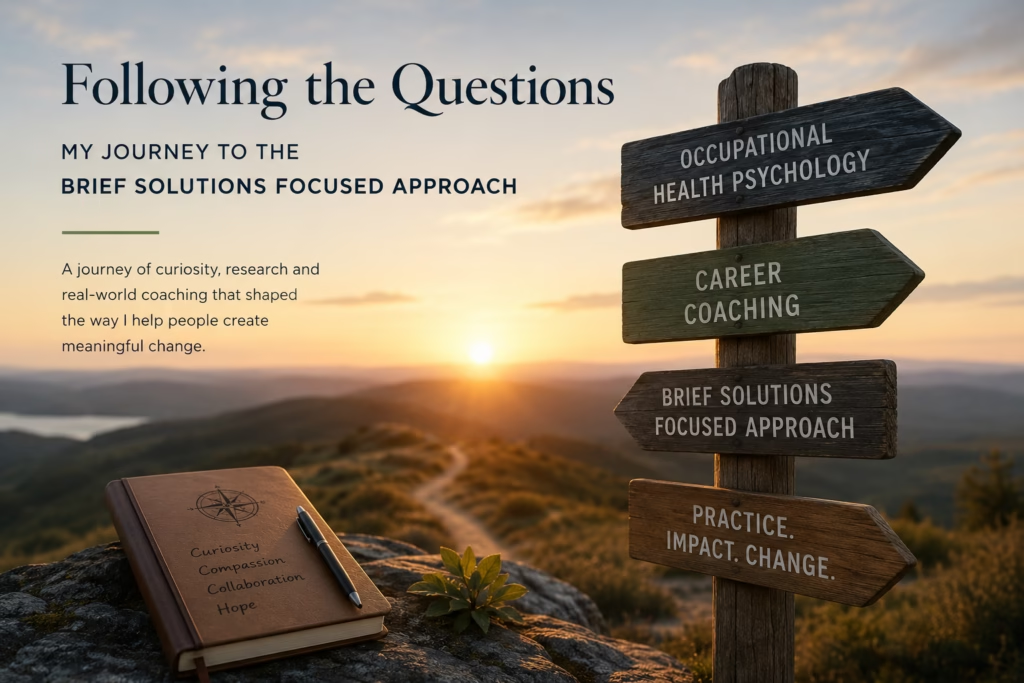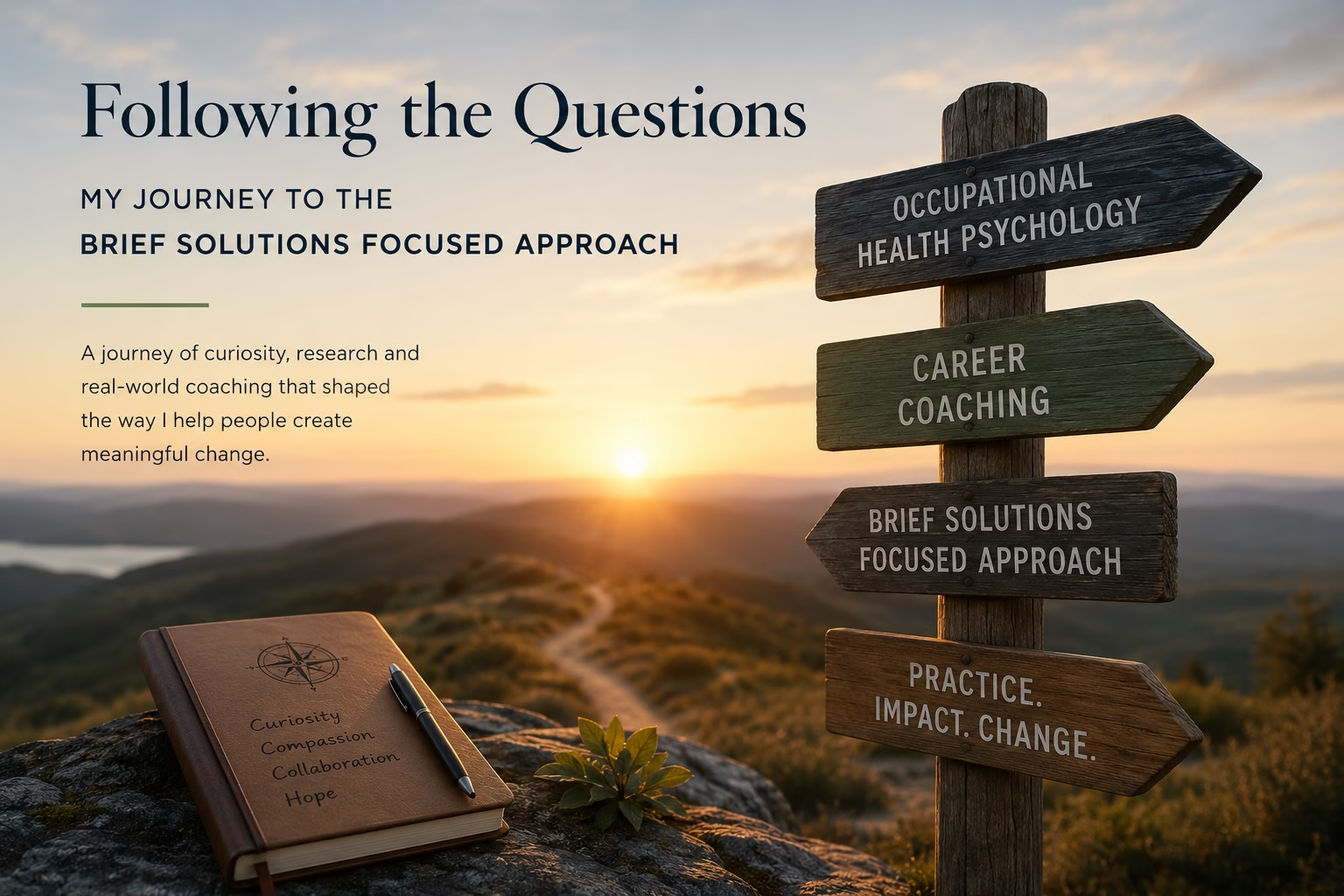
Following the Questions: My Journey to Brief Solution Focused Coaching
There is one question that has quietly guided my professional life for more than twenty years.
Why do some people, after experiencing unemployment, illness, disability, workplace stress or major setbacks, rediscover their confidence and move forward, while others—equally capable and often equally supported—remain stuck?
I’ve never believed the answer was as simple as intelligence, qualifications or willpower.
Instead, that question became the thread that connected everything I studied, every coaching conversation I had, and every professional decision I made.
Looking back now, I realise I wasn’t collecting qualifications or learning new coaching techniques.
I was following the questions.
Curiosity Before Coaching
Long before I called myself a coach, I was fascinated by people.
Working with individuals from every imaginable background, I noticed something that challenged my assumptions.
Two people could have similar qualifications, comparable work histories and face almost identical barriers.
Yet their lives could unfold in completely different ways.
One person would begin to rebuild confidence, notice opportunities and create momentum.
The other, despite having every bit as much ability, could remain trapped by self-doubt, uncertainty or past experiences.
I wanted to understand why.
That curiosity became the foundation of everything that followed.
Understanding Wellbeing
My search first led me to study Occupational Health Psychology.
Initially, I expected to discover clear explanations for workplace stress, wellbeing and performance.
Instead, I encountered a discipline that encouraged curiosity rather than certainty.
The more I studied stress, burnout, organisational psychology and human behaviour, the more I realised that people’s experiences cannot simply be explained by what happens to them.
They are shaped by the meaning they attach to those experiences.
Two people can work in the same organisation, report to the same manager and carry similar workloads, yet experience their working lives completely differently.
That insight fundamentally changed the way I thought about people.
My dissertation questioned some of the assumptions underpinning established approaches to workplace stress and reinforced a belief that has stayed with me ever since: if we genuinely want to help people, we must first understand the world as they experience it—not as we imagine it to be.
Yet my studies also left me with another question.
If meaning shapes experience so profoundly, where does that meaning come from?
Understanding Motivation
That question naturally led me to my Master’s in Career Coaching.
Here my focus shifted from wellbeing to motivation.
My research explored the experiences of people participating in labour market activation programmes.
Every day I met people who had been told they needed to find work.
Many arrived because someone else wanted them to change.
A government department.
An employer.
A partner.
Society.
Yet the people who made lasting progress rarely stayed motivated for those reasons.
Something changed.
During coaching conversations, their language changed.
Their reasons changed.
Their future began to belong to them rather than to someone else’s expectations.
It was during this research that I encountered Self-Determination Theory, developed by Richard Ryan and Edward Deci.
Their work suggests that lasting motivation flourishes when three psychological needs are supported:
- Autonomy — feeling that our choices genuinely belong to us.
- Competence — believing we are capable of succeeding.
- Relatedness — feeling understood, respected and connected with others.
Suddenly, much of what I had observed in practice began to make sense.
People weren’t becoming motivated because someone convinced them.
They were rediscovering motivation that had often become buried beneath disappointment, fear, failure or years of external pressure.
That insight continues to shape every coaching conversation I have today.
When Theory Met Reality
Research gave me ideas.
Practice tested them.
Over the past two decades, I have had the privilege of supporting hundreds of people through career transitions and helping more than 350 individuals move into employment.
I’ve worked with school leavers and senior executives.
People living with autism, ADHD, acquired brain injuries, physical disabilities and long-term health conditions.
People rebuilding their confidence after redundancy, illness, burnout and significant life changes.
Every conversation taught me something.
Despite their very different circumstances, I kept noticing the same pattern.
Breakthroughs rarely happened because someone finally understood every detail of their problem.
They happened when people recognised a strength they had forgotten, remembered a previous success, noticed an exception to the problem or caught a glimpse of the future they wanted.
Progress began long before the problem had disappeared.
Finding a Coaching Philosophy
Then I encountered the Brief Solution Focused Approach.
I still remember the feeling.
It wasn’t excitement at discovering something completely new.
It was recognition.
This was the framework that connected everything I had been exploring for years.
Occupational Health Psychology had taught me to understand people’s lived experience.
Career Coaching had helped me understand motivation.
The Brief Solution Focused Approach brought those ideas together in a way that was practical, respectful and deeply optimistic.
Rather than analysing problems in endless detail, it invited people to describe the future they wanted to create.
Rather than assuming the coach possessed the answers, it recognised clients as the experts in their own lives.
Rather than concentrating on deficits, it looked for strengths, resources, exceptions and possibilities that already existed.
It wasn’t about ignoring problems.
It was about refusing to let problems define people.
Deepening My Practice
Finding the approach was only the beginning.
Understanding a philosophy is very different from embodying it.
I wanted to become the kind of coach who could consistently translate these ideas into meaningful conversations that respected every client’s autonomy, dignity and expertise.
That commitment led me to undertake professional coach education with SolutionsAcademy, one of the world’s leading providers of Solution Focused coach training. The programme challenged me to move beyond techniques and develop the mindset, discipline and reflective practice expected of professional coaches working to internationally recognised EMCC and ICF standards.
What I valued most was not learning better questions.
It was learning to listen differently.
To notice strengths before deficits.
To hear possibility where others might hear only problems.
To remain genuinely curious rather than rushing towards solutions.
My learning continued through extensive training with BRIEF UK, studying with Chris Iveson, Evan George and Harvey Ratner, whose work has shaped modern Brief Solution Focused practice. Their teaching reinforced a belief that had been quietly developing throughout my academic studies and professional experience.
People rarely need someone to tell them how to live their lives.
They need conversations that help them reconnect with what already matters to them and recognise the resources they already possess.
The Coach I Strive to Be
Today, when someone asks about my coaching, I could list qualifications, accreditations and professional memberships.
Those things matter.
They ensure I work ethically, reflectively and according to internationally recognised standards.
But they are not what defines my coaching.
What defines it is a belief that has become stronger with every person I have had the privilege of work alongside.
People are far more resourceful than they usually believe.
Stress can hide that resourcefulness.
Failure can silence it.
Life can make us forget it.
My role is not to fix people.
It is not to diagnose them.
It is not to tell them what they should do.
My role is to create conversations that help people rediscover their strengths, reconnect with what matters most and take meaningful steps towards the future they want.
Looking back, I can now see that every stage of my journey was pointing in the same direction.
Occupational Health Psychology taught me to understand wellbeing.
Career Coaching taught me to understand motivation.
SolutionsAcademy helped me become a more skilful and reflective coach.
BRIEF UK refined my Solution Focused practice.
And thousands of coaching conversations have reminded me that no theory is more valuable than genuine curiosity about another human being.
After all these years, I still find myself returning to the same question that started everything.
Not “What’s wrong?”
But “What becomes possible when someone begins to see themselves differently?”
That is the conversation I hope every client experiences.