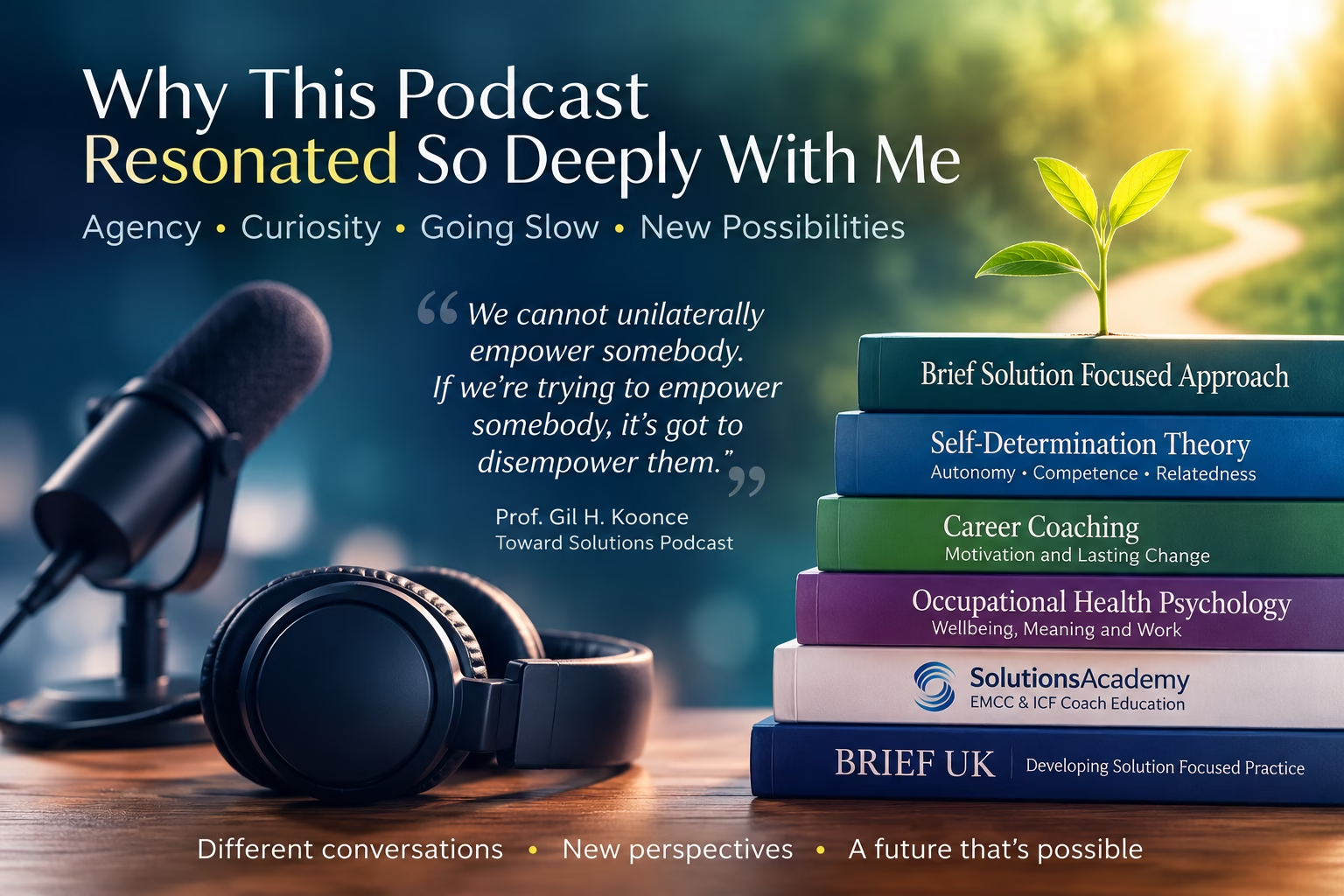
Mirrors my journey
Every so often I come across a podcast that doesn’t simply teach me something new—it helps me understand my own professional journey more clearly.
Recently I listened to Toward Solutions Podcast – Episode 13: Neurons, Agency and Going Slow featuring Professor Emeritus Gil Greene in conversation with Deon Singh and Jason Pascoe.
It is one of those rare conversations that I found myself pausing, replaying and reflecting on.
Not because it introduced a completely new idea.
But because it articulated, with remarkable clarity, many of the principles that have quietly shaped my own journey towards the Brief Solution Focused Approach.
If you’re interested in coaching, psychology, leadership, education or simply how people create meaningful change, I highly recommend taking the time to listen to it.
Following Questions Rather Than Methods
One of the reasons the conversation resonated so strongly with me is that Professor Koonce describes his professional development not as discovering a technique but as an evolution of thinking.
That mirrors my own experience.
My journey didn’t begin with Solution Focused coaching.
It began with questions.
Why do some people flourish despite enormous adversity while others remain stuck?
Why do some conversations leave people feeling more hopeful, capable and motivated while others reinforce feelings of helplessness?
Those questions first led me into Occupational Health Psychology, where I became fascinated by wellbeing, stress and how people interpret their experiences.
They later led me into Career Coaching, where I explored motivation through the lens of Self-Determination Theory.
Only afterwards did I discover the Brief Solution Focused Approach.
Listening to Professor Koonce describe his own evolution reminded me that good coaching philosophies are rarely adopted overnight.
They are usually discovered slowly through curiosity, experience and reflection. fileciteturn1file0
Agency Rather Than Advice
Perhaps the most powerful part of the conversation centres on agency.
Professor Koonce argues that we cannot simply empower another person.
In fact, trying to “empower” someone from an expert position may unintentionally disempower them.
That observation immediately reminded me of Richard Ryan and Edward Deci’s work on Self-Determination Theory.
Throughout my research into motivation, one message kept appearing.
Lasting change rarely happens because someone tells us what to do.
It happens when we begin to experience ourselves as capable of making meaningful choices.
Autonomy.
Competence.
Relatedness.
These psychological needs become the foundation for sustainable motivation.
What struck me while listening was how naturally this connects with the Brief Solution Focused Approach.
Rather than positioning ourselves as experts with answers, we create conversations that help people rediscover their own expertise.
That is a very different way of thinking about coaching.
And, in my experience, a far more respectful one. fileciteturn1file0
The Importance of Different Conversations
Another idea that resonated deeply was Professor Koonce’s observation that the more we talk about something, the more we reinforce it.
If we continually explore problems, shortcomings and failures, those stories become increasingly dominant.
Solution Focused conversations do something different.
They invite people to notice exceptions.
Strengths.
Previous successes.
Resources.
Possibilities.
That doesn’t mean ignoring problems.
Far from it.
Problems matter.
Pain matters.
People deserve to have their stories heard.
Professor Koonce makes this point beautifully later in the conversation when he talks about giving people space to tell their story before inviting them towards the future.
That balance is something I have come to value enormously in my own coaching.
Being Solution Focused is not about rushing people away from difficulty.
It is about ensuring that difficulty does not become the only story available to them. fileciteturn1file0
Why Going Slow Matters
One section of the podcast particularly challenged me.
Professor Koonce argues that one of the best ways to achieve genuinely brief therapy is, paradoxically, to go slowly at the beginning.
That feels counterintuitive.
Many of us, particularly when we first begin coaching, feel an almost irresistible urge to help quickly.
To solve.
To advise.
To move the conversation forward.
Yet over the years I have gradually learned exactly what he describes.
People change more readily when they first feel deeply understood.
Sometimes the most valuable thing we can offer another human being is not an answer.
It is our undivided attention.
As someone who has spent many years coaching individuals through unemployment, disability, career transition and significant life challenges, I have seen this repeatedly.
When people feel genuinely listened to, something begins to shift.
Hope returns.
Confidence grows.
Possibilities emerge.
Only then does the conversation naturally begin moving towards solutions.
Listening to Professor Koonce describe this reminded me how easy it is to become fascinated by techniques while forgetting that the quality of our presence remains the most important intervention of all. fileciteturn1file0
Neurons, Creativity and New Possibilities
The podcast also explores fascinating connections between neuroscience and Solution Focused practice.
The discussion around Hebb’s principle—“neurons that fire together wire together”—offers a compelling explanation for why different conversations matter.
When clients are invited to imagine preferred futures, notice exceptions and describe what is already working, they are not simply answering questions.
They are creating new connections.
New ways of seeing themselves.
New possibilities.
That idea resonates strongly with my own experience.
Again and again I have watched people leave coaching sessions seeing opportunities that had existed all along but had previously remained invisible.
The world had not changed.
What had changed was what they were now able to notice. fileciteturn1file0
Why This Conversation Felt Personal
As I listened to the episode, I realised that it wasn’t simply confirming ideas I had studied.
It was connecting the different stages of my own journey.
Occupational Health Psychology taught me to think deeply about wellbeing.
Career Coaching introduced me to the science of motivation.
Professional coach education through SolutionsAcademy, working to internationally recognised EMCC and ICF standards, challenged me to embody these ideas rather than simply understand them.
Training with BRIEF UK refined my Solution Focused practice still further.
Most importantly, thousands of coaching conversations have continually reminded me that people are rarely lacking strengths.
More often, they have temporarily lost sight of them.
That is why I continue to believe that coaching is not about fixing people.
It is about creating conversations that help people rediscover what has always been there.
Listening to Professor Koonce’s reflections felt less like hearing a new philosophy and more like meeting someone who had travelled a remarkably similar road.
My Recommendation
If you are curious about the Brief Solution Focused Approach, don’t begin with the techniques.
Begin with the thinking.
This episode explores ideas that sit at the heart of respectful, collaborative and evidence-informed coaching:
- Why agency matters more than advice.
- Why empowerment cannot be given—it must emerge through collaboration.
- Why curiosity is more powerful than expertise.
- Why going slowly often leads to faster change.
- Why different conversations literally help people think differently.
For me, it wasn’t simply an excellent podcast.
It was a reminder of why I coach the way I do.
And for that reason alone, I think it is well worth listening to.